Guangzhou A.C.T Products Co.,Ltd To Make The Global Delivery More Efficient
When a Standard Food Delivery Bag Is Too Small: Designing Large-Capacity Insulated Bags for Catering and Multi-Order Delivery
September 14, 2026


Table of Contents

  1. Why Large-Volume Delivery Needs a Different Bag Structure
  2. Why 15mm Insulation Makes Sense for Longer Holding Times
  3. How Five-Side Hard Board Support Changes Loading Stability
  4. Why Removable Support Panels Are Better Than Permanent Rigidity
  5. Internal Dividers for Multi-Order and Mixed Food Delivery
  6. Waterproof Zippers and Magnetic Front Access for Faster Loading
  7. Side Handles, D-Rings, and Bottom Straps for Vehicle-Based Delivery
  8. Why Bottom Feet Matter on a Commercial Insulated Delivery Bag
  9. Why Choose DeliverKingdom for Large-Capacity Custom Delivery Bags
  10. What Buyers Should Test Before Approving Bulk Production

Why Large-Volume Delivery Needs a Different Bag Structure

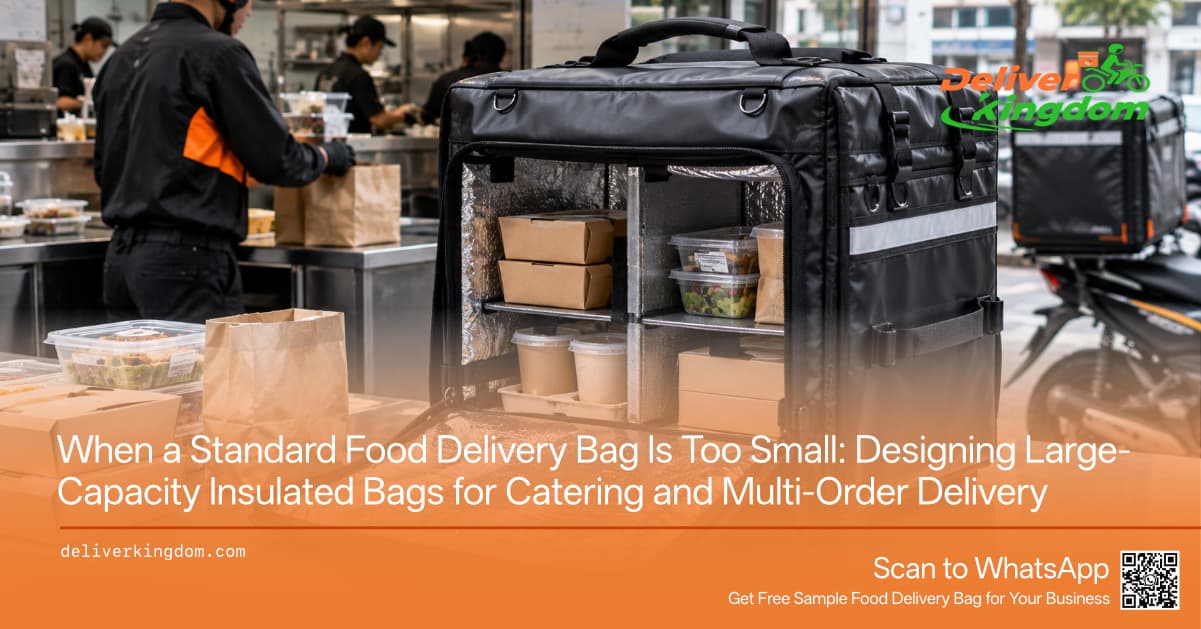
There is a point where making a food delivery bag “bigger” stops being enough. Once the bag is intended to carry multiple meal boxes, grocery orders, catering containers, bottled drinks, or several customer orders at the same time, the structure starts behaving very differently from a normal rider backpack. Large side panels can collapse inward when the bag is half loaded. Heavy contents can push the bottom downward. Food boxes can slide during vehicle movement, and loading becomes frustrating if the opening cannot hold its shape. This type of large capacity insulated food delivery bag is therefore better suited to catering routes, central kitchen distribution, supermarket delivery, large restaurant orders, multi-order dispatch, and vehicle-based food transport than ordinary single-order courier work. DeliverKingdom approaches these projects by looking first at how the bag will be loaded, carried, placed inside a vehicle, opened during delivery, and stored after use. The goal is not simply maximum capacity. It is creating a stable working space that remains practical when the bag is full, half full, or being moved between a kitchen and a vehicle.

Why 15mm Insulation Makes Sense for Longer Holding Times

Thicker insulation becomes more important when the internal volume increases. A larger bag contains more air and is often used for longer routes or larger batches of food, meaning temperature control becomes more challenging than in a compact takeaway bag. A 15mm foam insulation layer gives a large capacity insulated food delivery bag a stronger thermal barrier while also adding some structural body to the walls. Combined with an aluminum foil inner lining, the construction can help slow temperature exchange during catering delivery, central kitchen distribution, grocery transport, and multi-stop meal routes. However, thickness alone should not be treated as the entire thermal solution. Zipper design, opening size, seam construction, the number of times the bag is opened, and how full the bag is all influence performance. DeliverKingdom can adjust insulation structure according to food type and route conditions instead of simply using the thickest material available. A large catering order may need longer thermal holding, while a short supermarket route may value lighter weight and easier handling. The correct insulation structure should support the actual delivery scenario rather than turn the bag into an oversized padded cube that nobody enjoys moving.

How Five-Side Hard Board Support Changes Loading Stability

Large insulated bags often fail structurally before they fail thermally. Without sufficient support, the walls bow outward, the opening loses its shape, and stacked food containers lean into one another. Using multiple hard support boards around the main body helps maintain a more predictable rectangular loading space. This is particularly useful for bulk food delivery, where meal boxes, grocery cartons, drink packages, or catering trays need to remain organized rather than collapse toward the center. A reinforced insulated delivery bag with hard board structure can also make loading faster because staff do not need to hold the sidewalls open while placing orders inside. Support panels help distribute pressure across the bag and protect softer insulation materials from repeated deformation. For DeliverKingdom, the important design question is not simply how many boards are installed, but where stiffness is actually needed. The base and major sidewalls usually carry the most structural responsibility, while selected flexible zones can make the bag easier to fold or handle. This balance between rigidity and flexibility is what makes a large-capacity commercial bag useful rather than merely impressive when photographed empty.

Why Removable Support Panels Are Better Than Permanent Rigidity

Permanent rigid walls can make a large delivery bag stable, but they also create storage and cleaning problems. A fully rigid bag occupies its full volume even when it is empty and can be difficult to clean around internal seams or damaged support panels. Removable hard boards accessed through zipper compartments provide a more flexible solution. The buyer can remove structural panels when the bag needs deeper cleaning, maintenance, replacement, or flatter storage. This is especially valuable for a foldable large capacity food delivery bag used by catering companies, central kitchens, restaurant fleets, or food logistics operators with limited warehouse space. DeliverKingdom can design the support-board compartments so that the panels remain secure during daily use but can still be removed without dismantling the entire product. This also makes long-term maintenance more practical. If one board becomes damaged after repeated loading, replacing the panel may be more economical than replacing the complete bag. Commercial equipment should be designed for what happens after six months of use, not only for the moment when the sample is placed neatly on a meeting table and everybody nods at it.

Internal Dividers for Multi-Order and Mixed Food Delivery

A large open compartment can carry a lot, but capacity without organization often creates new problems. Multiple customer orders may become mixed together, heavy grocery items can move into lighter food containers, and drinks may tip when the vehicle turns or brakes. An internal divider allows operators to split the main cavity into more manageable zones. For a custom catering delivery bag with divider, one section might hold hot meal boxes while another carries drinks or side dishes. A central kitchen might separate different destinations. A grocery delivery operation could use one side for fragile products and another for heavier packaged goods. DeliverKingdom can customize the divider position, stiffness, height, attachment method, and removability according to the application. A divider without cut-outs creates stronger separation between sections and can help reduce direct contact between different cargo groups. The important point is that internal layout should follow the workflow. Adding a divider simply because the specification asks for one is easy. Designing it so that staff can load, remove, and reorganize orders quickly during actual dispatch is what turns the feature into useful operating value.

Waterproof Zippers and Magnetic Front Access for Faster Loading

Large delivery bags are opened repeatedly during loading and delivery, so the closure system has a direct impact on rider and staff efficiency. A waterproof zipper helps protect the insulated compartment from rain and splashes, particularly when the bag is used around motorcycles, loading docks, outdoor catering sites, or grocery delivery vehicles. SBS waterproof zipper construction offers a practical combination of durability and weather resistance for repeated commercial use. A magnetic front closure can complement the zipper by giving staff faster temporary access during loading or short handoff stages. This is useful when the bag needs to remain partially closed without fully operating a long zipper every time. For a waterproof large capacity insulated delivery bag, DeliverKingdom looks at the entire access pattern rather than evaluating the zipper as an isolated component. The opening needs to be wide enough for large meal containers, but it should also close securely enough to protect temperature. Magnetic assistance can improve convenience, while the zipper provides the stronger final seal. The result is a bag that can work efficiently during busy dispatch without sacrificing the structural and thermal protection needed during transport.

Side Handles, D-Rings, and Bottom Straps for Vehicle-Based Delivery

A large insulated bag is not always carried like a backpack. In many commercial operations, it is lifted from a central kitchen, moved into a van or motorcycle, secured during transport, then carried a short distance to the receiving point. Side handles become important because they allow one or two workers to lift the bag more naturally, especially when it contains multiple orders. D-rings create additional attachment possibilities for straps, securing systems, or operating accessories. A bottom securing strap is particularly relevant when the bag is used on a motorcycle platform, delivery rack, trolley, or other vehicle-based system. It helps reduce movement when the vehicle accelerates, brakes, or turns. DeliverKingdom can customize the position and reinforcement of these load-bearing components according to how the bag will actually be transported. For a vehicle mounted insulated food delivery bag, the attachment system needs to work together with the rigid internal structure. A strong bag that slides around on the vehicle is still a poor delivery solution. Large-capacity design therefore has to consider both the food inside and the vehicle underneath it.

Why Bottom Feet Matter on a Commercial Insulated Delivery Bag

Small bottom feet may seem like an insignificant feature, but they make more sense on a large commercial delivery bag than many buyers initially expect. Catering and food logistics bags are frequently placed on restaurant floors, loading docks, sidewalks, vehicle platforms, warehouses, and customer receiving areas. Direct contact with wet or dirty surfaces increases wear on the bottom fabric and makes cleaning more difficult. Raised bottom supports create a small gap between the main fabric and the ground, helping reduce direct abrasion and moisture contact. On a reinforced insulated delivery bag with hard board structure, the feet also work together with the rigid bottom panel to create a more stable base when the bag is standing during loading. DeliverKingdom can reinforce these attachment points because the weight of a loaded bag eventually transfers through the bottom structure. The feature is simple, but this is exactly the kind of practical detail that often separates equipment designed around real field use from a generic oversized thermal bag. Commercial delivery products spend a surprising amount of their lives sitting on surfaces nobody would willingly place food packaging directly onto.

Why Choose DeliverKingdom for Large-Capacity Custom Delivery Bags

Large-capacity insulated bags require more design judgment than simply scaling up a smaller backpack pattern. Insulation thickness, support panels, zipper length, handles, divider structure, vehicle attachment points, bottom reinforcement, and packing all become more important as the product grows. DeliverKingdom has focused on delivery equipment and insulated bag manufacturing since 2013 and operates a production facility covering more than 12,000 square meters in Yangchun, Guangdong, with over 400 employees. The company holds BSCI and ISO9001 certification and supports OEM and ODM projects involving materials, dimensions, colors, logo printing, thermal structures, compartments, hardware, and packaging. Buyers working on a custom catering delivery bag with divider or a vehicle mounted insulated food delivery bag can develop the product around actual food containers, route conditions, transport methods, and loading routines instead of selecting a standard model that is merely “close enough.” DeliverKingdom can also support sample development, commercial production, and repeat orders, giving restaurant groups, catering businesses, grocery delivery companies, food logistics operators, and trading companies a clearer path from specification to long-term supply.

What Buyers Should Test Before Approving Bulk Production

The prototype stage should recreate the real job the bag will perform. Buyers should load actual food containers, grocery packages, drinks, or catering trays rather than filling the sample with lightweight material simply to judge its shape. The test should check whether the hard boards keep the walls stable, whether the divider remains in position, whether the bottom support stays flat, and whether staff can lift the loaded bag comfortably using the side handles. The waterproof zipper should be opened repeatedly, the magnetic front closure should be checked during fast loading, and the D-rings and bottom securing strap should be tested on the intended vehicle or trolley. Buyers should also remove and reinstall the hard support panels to verify that maintenance and cleaning are practical. DeliverKingdom recommends confirming material, insulation, lining, hardware, structural support, label, packaging, and logo requirements through the approved sample before bulk production begins. A large capacity insulated food delivery bag may contain far more components than a standard thermal tote, so solving one structural detail during sampling is much cheaper than discovering the same problem across hundreds or thousands of finished units.

FAQ

Q: What types of delivery operations are suitable for a large-capacity insulated bag with rigid support?

A: This type of structure is suitable for catering delivery, central kitchen distribution, large restaurant orders, grocery delivery, multi-order routes, supermarket delivery, and vehicle-based food transport where a stable loading cavity and stronger insulation are required.

Q: Why use removable hard boards instead of permanently rigid panels?

A: Removable hard boards help maintain the bag’s shape during use while making cleaning, maintenance, replacement, and storage easier. They can provide commercial-level structural support without turning the bag into a permanently rigid delivery box.

Q: What is the purpose of an internal divider?

A: An internal divider helps separate food categories, customer orders, drinks, groceries, or different delivery destinations. It can reduce movement inside the bag and make loading and unloading more organized during multi-order delivery.

Q: Why choose DeliverKingdom for a custom large-capacity food delivery bag?

A: DeliverKingdom has manufactured delivery equipment since 2013 and operates a factory covering more than 12,000 square meters with over 400 employees. The company supports OEM and ODM development, materials, thermal structures, hard-board reinforcement, hardware, branding, sampling, bulk manufacturing, and repeat orders. DeliverKingdom also holds BSCI and ISO9001 certification.

Q: What should buyers test on the sample before mass production?

A: Buyers should test actual loading capacity, thermal structure, wall stability, divider position, zipper operation, magnetic closure, handles, D-rings, bottom securing system, bottom supports, cleaning process, removable panels, packaging, and compatibility with the intended vehicle or delivery workflow.

メッセージを残す

メッセージを残す
弊社製品にご興味があり、さらに詳しい情報をご希望の場合は、こちらにメッセージを残してください。できるだけ早く返信いたします。

製品

Facebook

whatsapp