Guangzhou A.C.T Products Co.,Ltd To Make The Global Delivery More Efficient
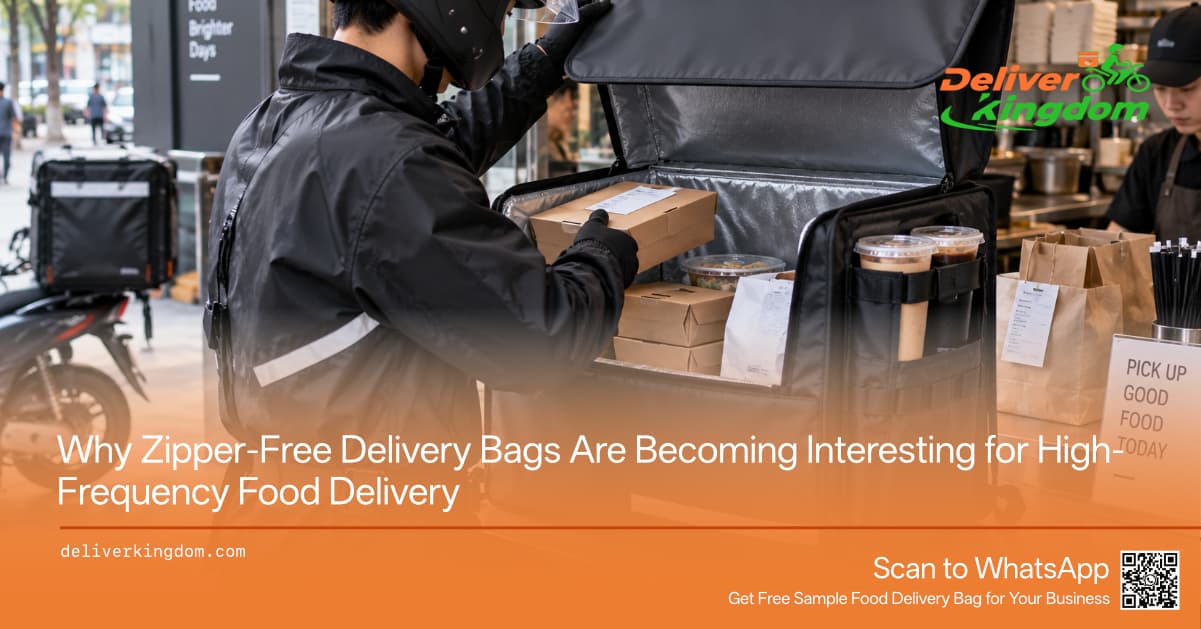
Why Zipper-Free Delivery Bags Are Becoming Interesting for High-Frequency Food Delivery
September 22, 2026

Table of Contents

  1. Why Frequent Opening Changes the Way a Food Delivery Bag Should Be Designed
  2. What a Zipper-Free Top Lid Can Improve During Restaurant Pickup
  3. How Hidden Magnetic Closures Balance Speed and Security
  4. Why a Separate Drink Compartment Solves More Than Spill Problems
  5. Using an Overlapping Lid to Improve Rain Protection
  6. Why Washable Thermal Lining Matters in High-Frequency Delivery
  7. Foldable Construction for Riders, Restaurants, and Fleet Storage
  8. What Buyers Should Test Before Approving a Magnetic Delivery Bag
  9. Why Choose DeliverKingdom for a Custom Zipper-Free Delivery Bag
  10. Turning a Prototype into a Repeatable Commercial Product

Why Frequent Opening Changes the Way a Food Delivery Bag Should Be Designed

A rider making occasional deliveries can tolerate a few extra seconds when opening and closing a bag. A high-frequency food delivery operation is different. During lunch and dinner peaks, the same courier may open the food delivery bag dozens of times while collecting orders, checking contents, separating drinks, handing meals to customers, and preparing for the next pickup. At that point, the closure system becomes part of the workflow. A recent OEM project focused on a custom insulated delivery bag designed around one large top lid, a zipper-free opening, hidden magnetic closure, a separate drink section, and a flexible foldable body. The idea is simple: reduce the number of actions required every time the rider reaches into the bag. Instead of operating a long zipper around several corners, the rider can lift the lid, access the order, and close it again quickly. For restaurant delivery fleets, cloud kitchens, local courier services, and takeaway brands, those few saved seconds become meaningful when repeated hundreds or thousands of times across an entire fleet.

What a Zipper-Free Top Lid Can Improve During Restaurant Pickup

Zippers are useful because they provide strong closure, but they also introduce friction into repeated delivery work. A long zipper may require two hands when the bag is full, particularly if the corners are under tension. Riders can also leave the zipper partly open during busy periods because reopening it at every pickup feels inconvenient. A zipper-free insulated food delivery bag takes a different approach. A single large top lid gives restaurant staff a wide loading area and allows riders to reach the main compartment without tracing a zipper around the bag. This can be especially useful for boxed meals, burgers, takeaway containers, bakery orders, and other products that are loaded from above. The design also reduces the number of zipper components that can wear during repeated opening cycles. However, removing the zipper does not mean removing structure. The lid shape, overlap depth, magnetic positions, insulation, and edge stiffness all have to work together so the bag closes naturally after each use. DeliverKingdom can develop these details around the actual pickup workflow rather than simply replacing a zipper with magnets and hoping optimism handles the engineering.

How Hidden Magnetic Closures Balance Speed and Security

Magnetic closures are attractive in delivery equipment because they require very little effort from the rider. The lid can align and close without the repetitive pulling motion required by a zipper or the noise and resistance associated with large Velcro areas. Hidden magnets also keep the exterior visually clean, which works particularly well for minimalist branded delivery bags. But magnet strength needs to be selected carefully. If the magnetic force is too weak, the lid may lift during movement or wind exposure. If it is unnecessarily strong, riders may need more effort to open the bag while holding food in the other hand. The placement matters as much as the magnet itself. Several closure points may provide better lid alignment than relying on one central magnet. For a custom magnetic food delivery bag for restaurant couriers, DeliverKingdom would also evaluate how the closure behaves when the bag is partially empty, fully loaded, or slightly deformed after repeated folding. Magnetic closure is valuable because it makes access faster, but the design still needs enough overlap and structural control to protect the contents during ordinary urban delivery.

Why a Separate Drink Compartment Solves More Than Spill Problems

Drinks are one of the most troublesome items inside a food delivery bag. They are tall, unstable, often cold, and particularly enthusiastic about leaking at the least convenient moment. Placing takeaway cups beside hot meal boxes creates several problems at once. The drinks can tip during braking, condensation can make food packaging damp, and cold beverages exchange heat with hot meals. A dedicated drink compartment gives the rider a separate zone where cups can remain upright and easier to access. It also reduces the need to open or disturb the main meal compartment when the customer has both food and beverages. For mixed restaurant orders, this creates a cleaner loading routine: hot meals stay together, while drinks remain in their own section. DeliverKingdom can customize the drink area with removable holders, dividers, waterproof lining, or different internal support depending on the cup sizes and delivery model. A food delivery bag with integrated drink compartment is therefore not simply about preventing spills. It can improve temperature separation, order organization, cleaning, and handoff speed during high-frequency urban delivery.

Using an Overlapping Lid to Improve Rain Protection

Removing a zipper changes how rain protection needs to be handled. A conventional water-resistant zipper can create a defined closure line, while a zipper-free bag needs the top lid itself to help prevent water from entering. One practical approach is an overlapping rain-protection edge, where the lid extends beyond the upper opening and directs water away from the seam between the lid and main body. The same principle appears in many outdoor covers and protective equipment: instead of relying only on a closure component, the structure encourages water to flow past the opening. For a water-resistant magnetic food delivery bag, the overlap depth, lid stiffness, fabric coating, seam direction, and magnetic placement all affect the result. DeliverKingdom can combine a water-resistant exterior with this overlapping construction to improve performance during normal rain and short outdoor exposure. Buyers should still define the expected environment clearly. A bag designed for urban restaurant delivery in occasional rain has different requirements from equipment expected to sit uncovered through severe weather. “Water-resistant” and “fully waterproof” are not decorative synonyms, despite the heroic efforts of online product listings to make them so.

Why Washable Thermal Lining Matters in High-Frequency Delivery

Fast access is useful only if the inside of the bag remains practical after weeks of restaurant use. Delivery bags collect condensation, sauce, oil, crumbs, drink spills, and the occasional mystery substance nobody remembers ordering. A smooth washable thermal lining helps staff wipe the interior quickly between shifts and reduces the number of fabric surfaces that absorb moisture or odor. A grey or silver thermal interior can also make dirt easier to identify during cleaning compared with very dark inner materials. For a zipper-free insulated food delivery bag, the wide top opening makes this cleaning process easier because staff can reach the base and corners without fighting a narrow opening. DeliverKingdom can select lining materials according to the desired balance of thermal performance, flexibility, cleanability, and cost. The internal seams and junction between the main compartment and drink section also deserve attention because liquids naturally migrate toward corners and stitch lines. In commercial delivery equipment, cleanability should be treated as part of the product structure, not an afterthought added after somebody discovers that last Tuesday’s curry is still participating in Friday’s deliveries.

Foldable Construction for Riders, Restaurants, and Fleet Storage

Rigid delivery boxes provide excellent shape retention, but they occupy their full volume even when completely empty. For restaurant chains and delivery fleets that keep spare bags at multiple locations, this creates unnecessary storage pressure. A flexible, semi-structured food delivery bag can provide another option. The body can use thermal foam and selected support materials to maintain enough shape during loading while remaining foldable when the bag is not in service. This is particularly useful for fleet operators that need reserve stock, seasonal bags, temporary riders, or compact return logistics. Foldability can also reduce packing volume for certain international shipments depending on the construction. The challenge is ensuring that repeated folding does not damage the insulation, distort the magnetic lid alignment, or weaken the drink compartment. DeliverKingdom can develop the structure so reinforcement remains where it is operationally necessary while other panels retain flexibility. The objective is not to create the softest possible bag. It is to create enough structure for restaurant delivery without permanently storing a large empty cube in every back room.

What Buyers Should Test Before Approving a Magnetic Delivery Bag

A zipper-free magnetic bag should be tested differently from a conventional delivery backpack. First, the buyer should load actual restaurant containers and cups, then check whether the lid falls naturally into the correct position without manual alignment. The magnets should remain secure during walking, vehicle movement, and ordinary vibration. The overlapping edge should be checked under rain or water-spray conditions to see where moisture travels around the lid. The drink compartment should be loaded with realistic cups and tested during sudden stopping and turning. Staff should also open and close the bag repeatedly to confirm that the magnetic system remains convenient after many cycles. Cleaning is another important test: spilled liquid should not become trapped in inaccessible areas between compartments. Finally, the bag should be folded and reopened several times to verify that the lid, thermal walls, and magnetic positions return to their intended shape. DeliverKingdom recommends using the prototype as an operating test rather than merely checking color and logo placement. The whole point of this structure is workflow improvement, so the sample should be judged while somebody is actually trying to work quickly.

Why Choose DeliverKingdom for a Custom Zipper-Free Delivery Bag

A magnetic zipper-free delivery bag looks visually simple, but developing it correctly requires coordination between fabric, insulation, lid geometry, magnetic placement, compartment structure, rain protection, and foldability. DeliverKingdom has worked in delivery equipment manufacturing since 2013 and operates a production facility covering more than 12,000 square meters in Yangchun, Guangdong, with over 400 employees. The company supports OEM and ODM development for food delivery bags, insulated backpacks, thermal totes, rider equipment, and other commercial delivery products. Buyers can customize outer materials, thermal lining, insulation, colors, logo areas, drink compartments, internal dividers, closures, carrying systems, and packaging. DeliverKingdom also holds BSCI and ISO9001 certification, providing useful references for factory and quality-management evaluation. For an unconventional structure such as a custom magnetic food delivery bag for restaurant couriers, the value is not simply manufacturing the requested drawing. DeliverKingdom can help turn the requested user experience, quick access, cleaner organization, better rain protection, and easier storage, into construction details that can actually be sampled and tested.

Turning a Prototype into a Repeatable Commercial Product

An innovative closure concept should prove itself before moving into commercial production. The prototype stage gives the buyer an opportunity to verify magnetic strength, lid alignment, rain overlap, drink stability, thermal lining, carrying comfort, foldability, cleaning, branding space, and overall rider workflow. Feedback from this stage can then be converted into a fixed production specification covering materials, magnet positions, stitching, panel dimensions, insulation, lining, compartment structure, color, logo placement, and packaging. This matters because a design that works through one carefully adjusted sample still needs to be reproduced consistently across later orders. DeliverKingdom can support this progression from prototype development into initial commercial quantities and future repeat production. For restaurant brands, food delivery companies, cloud kitchens, and fleet operators, the result is a delivery bag developed around actual operational behavior rather than another generic thermal backpack with a different logo. Buyers developing a similar zipper-free insulated food delivery bag can provide their typical food containers, drink cup formats, rider workflow, target quantity, preferred material, and branding requirements so the product can be built around the real delivery scene from the beginning.

FAQ

Q: Why would a food delivery bag use magnets instead of a zipper?

A: A magnetic closure can make repeated opening and closing faster during high-frequency restaurant delivery. It can also create a cleaner exterior design. The lid still needs sufficient overlap, structural support, and suitable magnet strength to remain secure during normal delivery use.

Q: Can a zipper-free food delivery bag still provide rain protection?

A: Yes. A water-resistant outer material can be combined with an overlapping lid edge that helps direct rain away from the main opening. The required level of rain protection should be defined during product development and verified through prototype testing.

Q: Why include a separate drink compartment?

A: A dedicated drink compartment helps keep takeaway cups upright and separates cold beverages from hot meals. It can reduce spills, condensation around food packaging, temperature interaction, and unnecessary movement inside the main compartment.

Q: Can a magnetic insulated delivery bag be foldable?

A: Yes. DeliverKingdom can develop flexible or semi-structured constructions that fold for storage while maintaining enough support during delivery. The prototype should be tested repeatedly to confirm that folding does not affect lid alignment, insulation, or magnetic closure performance.

Q: Why choose DeliverKingdom for a custom magnetic food delivery bag?

A: DeliverKingdom has worked in delivery equipment since 2013 and operates a factory covering more than 12,000 square meters with over 400 employees. The company supports OEM and ODM development, custom materials, thermal structures, compartments, closures, branding, sampling, bulk production, and repeat orders, with BSCI and ISO9001 certification supporting factory evaluation.

メッセージを残す

メッセージを残す
弊社製品にご興味があり、さらに詳しい情報をご希望の場合は、こちらにメッセージを残してください。できるだけ早く返信いたします。

製品

Facebook

whatsapp